Life with Braces
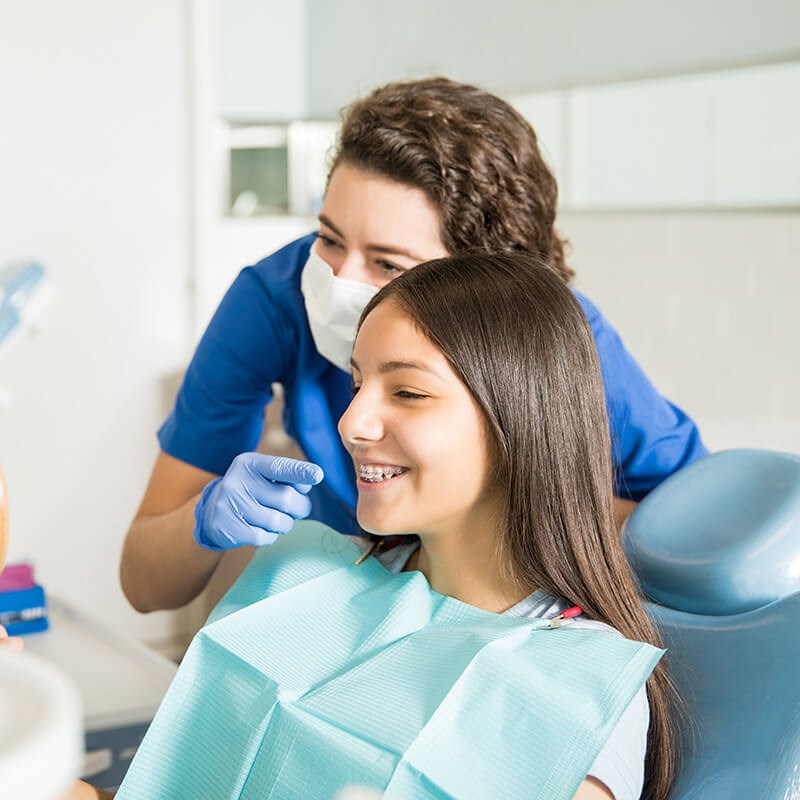
Playing Sports with Braces
If you play sports, it’s important that you wear a protective mouthguard designed for braces. They can be found in most retail sporting good stores, or ask us to provide one for you. In case of any accident involving the face, check your mouth and the appliances immediately. If teeth are loosened or the appliances damaged, phone at once for an appointment. In the meantime, treat your discomfort as you would treat any general soreness.
Brushing, Flossing and Regular Checkups
It’s more important than ever to brush and floss regularly when you have braces so the teeth and gums are healthy after orthodontic treatment. We recommend that patients brush after every meal and floss at least once a day with braces. Not doing so may result in cavities, gum disease, or permanent white spots on the teeth. It is also important to see your general dentist for cleanings and checkups at least once every 6 months.
Care of Appliances
To successfully complete the treatment plan, the patient must work together with the orthodontist. The teeth and jaws can only move toward their corrected positions if the patient consistently wears the rubber bands, headgear, or other appliances as prescribed. Damaged appliances lengthen the treatment time.
Loose Wire or Band
Don’t be alarmed if a wire or band comes loose. This happens occasionally. If a wire protrudes and is irritating, use a blunt instrument (the back of a spoon or the eraser end of a pencil) and carefully, gently push the irritating wire under the archwire. Simply get it out of the way. If irritation to the lips or mouth continues, place wax or wet cotton on the wire to reduce the annoyance. Call our office as soon as possible for an appointment to check and repair the appliances. If any piece comes off, save it and bring it with you to the office.
Loosening of Teeth
This is to be expected throughout treatment. Don’t worry! It’s normal. Teeth must loosen first so they can be moved. The teeth will again become rigidly fixed in their new – corrected – positions.
General Soreness
When you get your braces on, you may feel general soreness in your mouth and teeth may be tender to biting pressures for three to five days. This can be relieved by rinsing your mouth with a warm salt water mouthwash. Dissolve one teaspoonful of salt in 8 ounces of warm water and rinse your mouth vigorously. If the tenderness is severe, take whatever you normally take for headache or similar pain. The lips, cheeks, and tongue may also become irritated for one to two weeks as they toughen and become accustomed to the surface of the braces. You can put wax on the braces to lessen this. We’ll show you how!
Foods to Avoid
Chewy foods: bagels, hard rolls, licorice
Crunchy foods: popcorn, ice, chips
Sticky foods: caramels, gum
Hard foods: nuts, candy
Foods you have to bite into: corn on the cob, apples, carrots
Chewing on hard things (for example, pens, pencils or fingernails) can damage the braces. Damaged braces will cause treatment to take longer.
Eating Habits with Braces
Following proper eating instructions is an essential part of orthodontic treatment. What can you eat? Let’s talk about what you shouldn’t eat! For the first day or so, stick to soft foods. Avoid tough meats, hard breads, and raw vegetables. Before long, you’ll be able to bite a cucumber again. But you’ll need to take special care to avoid certain foods that may damage your new appliances.
Types of Braces
Metal Braces (Traditional and Self-Ligating)
Metal braces are the most common type of braces and are smaller, less noticeable and more comfortable today than ever before. Made of high-grade stainless steel, metal braces straighten your teeth using metal brackets and archwires. We also offer advanced self-ligating braces as well as traditional metal braces. With metal braces, you have the option of adding colored elastics (rubber bands) for a more unique and colorful smile.
Clear Braces (Traditional and Self-Ligating)
Ceramic braces are made of clear materials and are therefore less visible on your teeth than metal braces. These clear braces are a great option for older teens and adults who have cosmetic concerns, but are not candidates for Invisalign treatment. While they are visually less prominent, they do require more attention to oral hygiene as ceramic braces are larger and are more brittle than their metal counterparts. For these reasons, ceramic braces tend to be used more on upper front teeth than on lower teeth.
Clear Aligners (Invisalign and Invisalign Teen)
Invisalign and Invisalign treatment for teens use a series of clear plastic aligners that gradually move your teeth into their new positions. Invisalign aligner are made using 3D computer imaging technology, and has proven to be as effective as braces for many orthodontic problems. When you wear these nearly invisible aligners, you can smile more during treatment as well as after!
Types of Appliances
Wearing elastics (or rubber bands) improves the fit of your upper and lower teeth. Wear rubber bands as instructed and remember that the rubber bands work far more efficiently if they’re worn as prescribed.
The palatal expander “expands” (or widens) your upper jaw by putting gentle pressure on your upper molars each time an adjustment is made. Dr. Wang will instruct you about when and how to adjust your expander. When you achieve the desired expansion, you will wear the appliance for several months to solidify the expansion and to prevent regression.
Headgear is used to treat patients whose teeth are in an “overbite,” with the upper jaw forward of the lower jaw, or an “underbite” with the lower jaw forward of the upper jaw. Headgear gently “pulls” on your teeth to restrict further forward growth of your upper teeth and jaw.
The Carriere Appliance is an orthodontic device that focuses on helping to correct your bite by gently shifting your upper or lower molars and canines into the right position before braces or aligners are placed.
Retainers may be removable or fixed. They hold your teeth in their new, correct positions after your teeth have been straightened. Dr. Wang will instruct you on how to care for your retainer and about the duration of the wear. Wearing your retainer as directed is crucial to prevent regression of your treatment.
Retainer Instructions
- Wear your retainers full time, until the doctor instructs otherwise.
- Take your retainers out when eating…and always put retainers in their case! (Most appliances are lost in school lunchrooms or restaurants.)
- Clean retainers thoroughly once a day with a toothbrush and toothpaste. Use warm but not hot water. Brushing retainers removes the plaque, and eliminates odors. Efferdent® or other orthodontic appliance cleaners can be used, but do not take the place of brushing.
- When retainers are not in your mouth they should ALWAYS be in a retainer case. Pets love to chew on them!
- Initially, you may find it difficult to speak. Practice speaking, reading, or singing out loud to get used to them faster.
- Retainers are breakable, so treat them with care. If retainers are lost or broken call us immediately.
- If you have any questions or concerns about your retainers, or your retainers need adjusting, call us. Do not try to adjust them yourself.
- If you have any questions or concerns about your retainers, or your retainers need adjusting, call us. Do not try to adjust them yourself.
- Retainer replacement is expensive…with proper care they will last for years!
- Remove retainers when swimming.
- Keep retainers away from hot water, hot car dashboards, pockets, the washing machine, and napkins.
Emergency Care
True orthodontic emergencies are very rare, but when they do occur we are available for you. As a general rule, you should call the office when you experience severe pain or when you have a painful appliance problem that you can’t take care of yourself. We’ll be able to schedule an appointment to resolve the problem.
You might be surprised to learn that you may be able to temporarily solve many problems yourself until you schedule an appointment with our office. When working with your appliances, you need to know the names of the parts of your appliances so you are able to identify what part is broken or out of place. Allowing your appliance to remain damaged for an extended period of time may result in disruptions in your treatment plan.
How to handle a...
Using a pencil eraser, push the poking wire down or place wax on it to alleviate the discomfort.
If your bracket or band is still attached to the wire, you should leave it in place and put wax on it. If the wire comes out entirely, wrap the bracket with a tissue.
Using a tweezer, try to put your wire back into place. If doing this and using wax doesn’t help, as a last resort use a small fingernail clipper to clip the wire behind the last tooth to which it is securely fastened. If your discomfort continues, place wax on it.
If your appliance is poking you, place wax on the offending part of your appliance.
Sometimes headgear discomfort is caused by not wearing the headgear as instructed by your orthodontist. If the facebow is bent, please call our office for assistance. Surprisingly, the headgear may hurt less as it’s worn more, so be sure you’re getting in the prescribed hours.

